
Past News
Purdue Students On Way to Solving Fresh Water Security
May 19, 2021
Purdue University engineers have developed a variant of the process for making fresh water out of seawater, a move that could make a big difference in water security world-wide.
Awards highlight Hamaker’s practical and impactful research
May 12, 2021
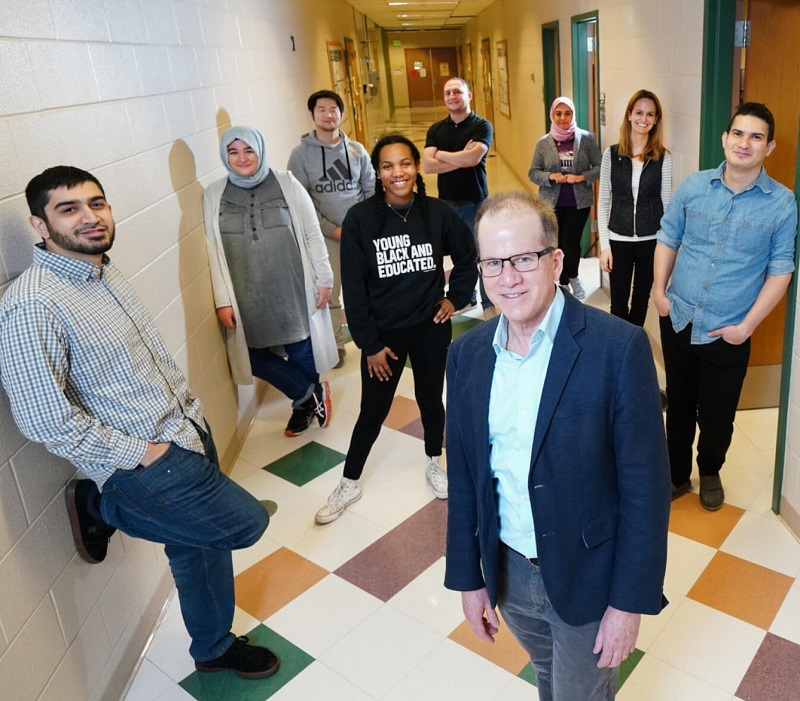
Before finding his profession and passion in agriculture and carbohydrate research, Bruce Hamaker pursued a number of different paths, which included nutritional sciences, dental school and two years in Liberia with the Peace Corps. Despite growing up in Indiana, Hamaker didn’t have any strong ties to agriculture or food production. He began a graduate degree in nutritional science at Purdue with the intention of applying it towards a career in international development. Quickly, however, Hamaker became captivated by food chemistry and the molecular makeup of carbohydrates.
Wildfires are contaminating drinking water systems, and it’s more widespread than people realize
May 10, 2021
More than 58,000 fires scorched the United States last year, and 2021 is on track to be even drier. What many people don’t realize is that these wildfires can do lasting damage beyond the reach of the flames – they can contaminate entire drinking water systems with carcinogens that last for months after the blaze. That water flows to homes, contaminating the plumbing, too.
Wildfires are contaminating drinking water systems, and it’s more widespread than people realize
Purdue Extension focuses on renewable energy education efforts
May 3, 2021
Purdue Extension is partnering with Hoosiers for Renewables and Indiana Farm Bureau to conduct a comprehensive study on land use regulations for wind and solar renewable energy and trends related to climate change planning in Indiana.
Purdue Extension focuses on renewable energy education efforts
First round of award recognizes exceptional efforts in teaching and instructional support during the COVID-19 pandemic
April 30, 2021
The Teaching Academy and Office of the Provost at Purdue are celebrating 241 individuals and teams of faculty, instructors, staff and graduate students who have been selected by their academic or administrative unit for the Award for Exceptional Teaching and Instructional Support during the COVID-19 Pandemic. Nominations were submitted by 65 units across campus.
First round of award recognizes exceptional efforts in teaching and instructional support during the COVID-19 pandemic
Food Safety Lab Announces Funding Opportunity for MSI-Led Partnerships for Global Food Safety Research
April 26, 2021
The Feed the Future Innovation Lab for Food Safety (FSIL), based at Purdue and Cornell universities, has announced a funding opportunity aimed at reducing foodborne illness in Africa, Asia and the Caribbean through research projects led by U.S.-based Minority Serving Institutions (MSIs).
Food Safety Lab Announces Funding Opportunity for MSI-Led Partnerships for Global Food Safety Research
Purdue will be new home for Midwestern Regional Climate Center
April 19, 2021
The National Oceanic and Atmospheric Administration has named Purdue University as the new host of the Midwestern Regional Climate Center (MRCC). Beth Hall, Indiana state climatologist, will direct the center for five years with $3.1 million in federal base funding.
Purdue will be new home for Midwestern Regional Climate Center
“Simple question” leads to multi-year research study about effects of alpine glacial meltwater on groundwater in mountainous regions
April 12, 2021
Alpine glaciers are formed high in the mountains and produce meltwaters that flow down the mountain. These meltwaters sustain life in mountain streams, lakes, and rivers. The meltwater from iconic frozen mountaintops is an essential building block to the Earth’s ecosystem, so when Jordyn Miller, PhD Candidate for Purdue Earth, Atmospheric, and Planetary Sciences (EAPS) asked her advisor a “simple” question years ago, she assumed there would be an answer readily available. She asked Dr. Marty Frisbee, EAPS hydrogeology professor, does meltwater from alpine glaciers contribute to mountain-block recharge and deep circulation within a mountain block. As it turns out, the simple question turned into a quest to deliver an answer because there is very little research in this area. In March of 2021, Miller published the first results of a multi-year research project
“Simple question” leads to multi-year research study about effects of alpine glacial meltwater on groundwater in mountainous regions
Listening to Nature Gives You a Real Rocky Mountain High
April 8, 2021
Miles away from the nearest road in Colorado’s Wheeler Geologic Area, the problem of noise pollution hit home for conservation biologist Rachel Buxton. ‘It was a gorgeous, remote valley, and then a plane flew over and you could hear the noise for ages as it reverberated in the valley,” she says. “I remember thinking, ‘wow, this is a really pervasive issue.’”
Teaching data science for smart agriculture

April 8, 2021
Technology is bringing tremendous advances to the practice of agriculture. For example, take the use of sensors and geographic information systems for precision, site-specific crop management, in which data are continuously collected directly in the fields using unmanned aerial systems (UAS) or satellite/aerial mounted sensors to monitor variables like soil nutrient status, moisture content, extent of pest infestation, etc.