Broader Impacts and Education Plans
Broader impacts are the potential to benefit society and contribute to the achievement of specific, desired societal outcomes. They may be accomplished through:
- Research
- Activities directly related to research projects
- Activities supported by and complementary to the project
A broader impact statement describes benefits and outcomes — not logistics.
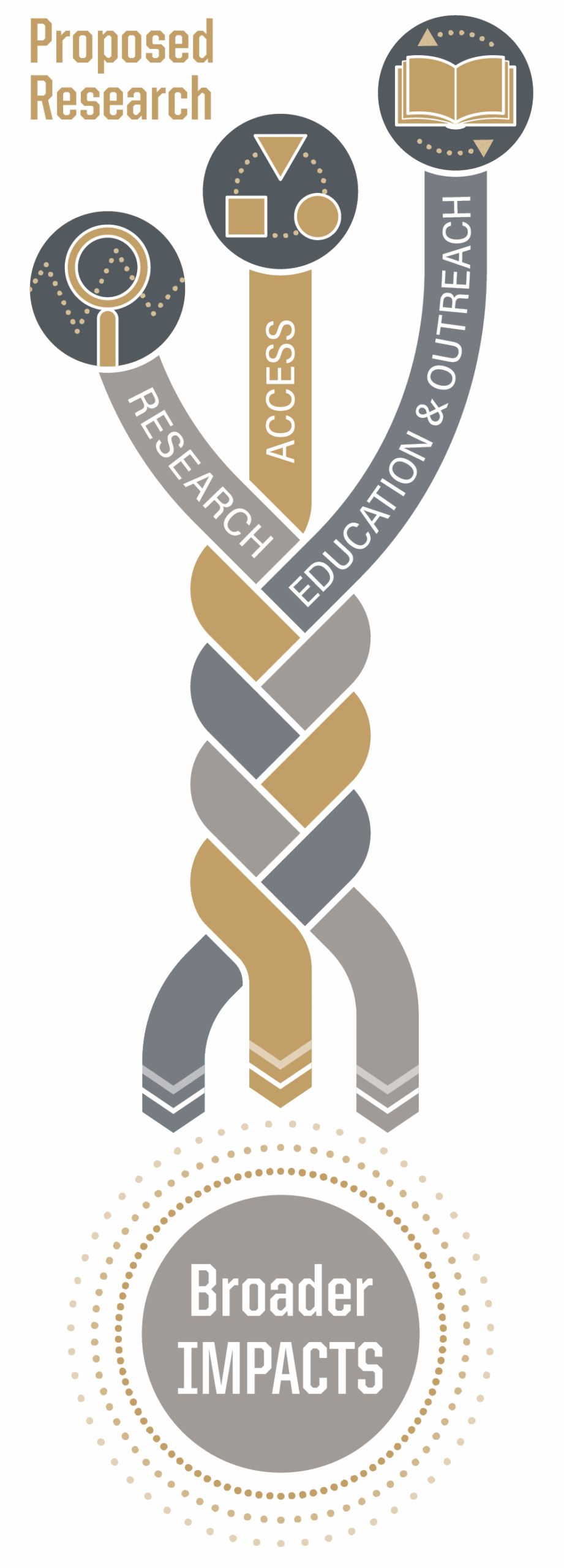
“Cords” of research, education and outreach and access-related activities integrate through your project to deliver broader impacts. For instance:
- Improved STEM Education and Educator Development
- Increased Public Scientific Literacy
- Improved Well-Being of Individuals
- Development of a Diverse, Globally Competitive Workforce
- Increased Partnerships among Academia, Industry, Government, and Non-Profits
- Improved National Security
- Increased U.S. Economic Competitiveness
- Informed Public Policy
- Enhanced Research and Education Infrastructure
Advancing Research Impact in Society (ARIS) publishes additional broader impacts resources and tools.
Steps to an Education and Workforce Development Plan
Many proposals require, or are strengthened by, an education and workforce development plan. While education plans drive broader impacts, they are often stand-alone sections with unique requirements.
The best education and workforce development (EWD) plans:
- Are tailored to the specific research
- Are sustainable and scalable
- Include the right expertise
- Leverage institutional resources
- Have rationale from the literature
- Add an appropriate budget
- Do not name partners without permission
We recommend following these six steps to build a strong Education and Workforce Development (EWD) Plan:
- Identify EWD gap(s)
- Identify interest, track record, and institutional context
- Determine audience
- Identify partners and resources
- Development plan to implement and assess
- Articulate broader impacts
Click each step below for more details on how to develop your own EWD plan.
STEP 1
Identify EWD Gap(s)
Pinpoint the education gap your plan addresses using the four EWD buckets — pathway, skill development, access and public literacy — and ground it in the literature.
View step 1STEP 2
Identify Interest, Track Record, and Institutional Context
Build a broader impacts identity from your own preferences, prior experience and Purdue’s institutional strengths.
View step 2STEP 3
Determine Audience
Decide who the plan serves — K-12 teachers and students, undergraduates, graduate students, postdocs, faculty or the wider public.
View step 3STEP 4
Identify Partners and Resources
Find the right partners, understand what each side needs, and map the Purdue programs and external organizations that can help.
View step 4STEP 5
Development Plan to Implement and Assess
Write goals and measurable objectives, set a realistic timeline and budget, and plan how you’ll evaluate and disseminate results.
View step 5STEP 6
Articulate Broader Impacts
Weave education and workforce development together with research and access, and place your statement in all three NSF-required locations.
View step 6