5. Development Plan to Implement and Assess
Now that you have identified your EWD gap, broader impact identity, and selected your audience and partner(s), it’s time to develop your plan to implement and assess your activities. Consider the following components when putting together your plan:
- Write the overall goal(s) for your EWD plan
- Goal(s) should target your gap and articulate the purpose of your EWD plan
- One or two high-level goals are enough
- Write measurable objectives to accomplish goal(s)
- Objectives can be per goal or cut across goals
- Objectives are “time bound”
- Be sure to work with your education partner to tailor initiatives and activities to their needs
- Determine a realistic timeline
- Consider using phased implementation, and including a timeline graphic such as the one below:
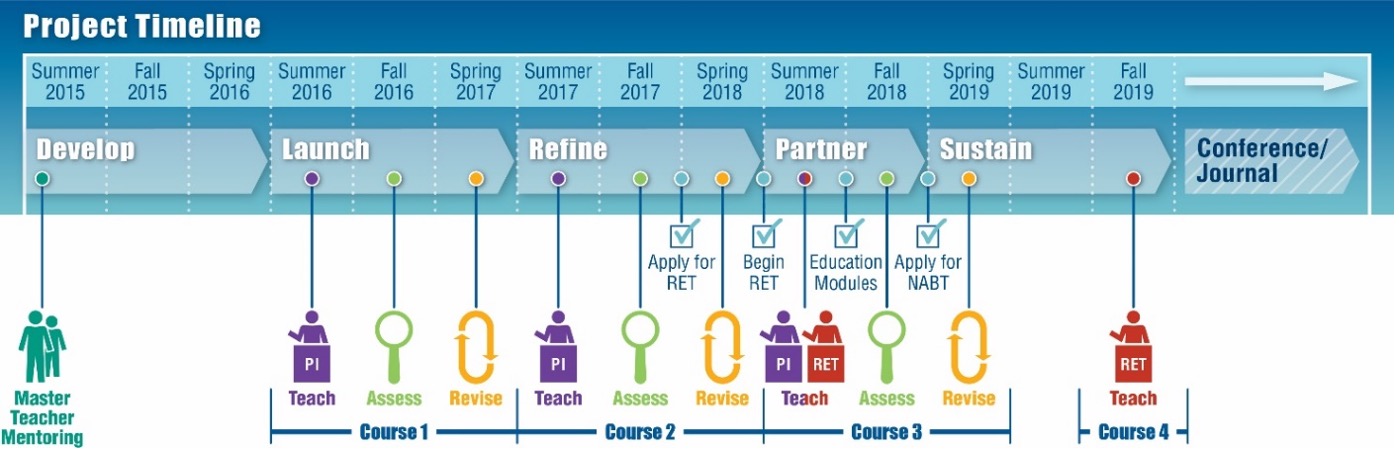
Timeline shows (a) camp curriculum development in partnership with pedagogical experts and (b) cycles of iterative teaching/assessing/revising. (c) High school teachers conduct summer research experience for teachers (RET) and (d) translate curriculum into educational modules for classroom use. (e) Teachers and graduate students disseminate modules at STEM education conference for scalability and professional development.
- Determine the number of participants and how you will recruit
- What can you budget?
- Leverage the existing recruiting mechanisms of your partners
- Add recruiting mechanisms that increase the likelihood of broad participation from under-resourced participants
- Articulate team member roles clearly
- Who will lead the education activities if not you?
- If collaborators are involved, what are their roles?
- Determine training needs as best practice preparation
- Do faculty members need guidance to mentor a broad range of students?
- Do you need a team kick-off meeting to review a data management plan?
- Cite literature that supports your initiatives as best practices
- Determine how you will assess/evaluate initiatives
- Leverage partner’s existing assessment tools and mechanisms
- Consider ARIS-promoted evaluation tools and the CU Boulder broader impacts project evaluation guidance
- Determine how you will disseminate results and products
- Leverage partner’s existing dissemination avenues
- Add tools and resources to online platforms, e.g. HUBzero, nanoHUB, YouTube, Chipshub (powered by nanoHUB)
- Identify what can be scaled/sustained beyond the project period
- Be specific about which workshops/conferences/journals you will disseminate results to

Questions?
Contact us at OORIntake@purdue.edu.