Get Started
Follow these steps to navigate the IRB process from start to finish.
Step 1: Complete Required Training*
All personnel involved in human research must complete CITI Human Research training before a study can be assigned for pre-review.
- Complete one of the following:
- Biomedical Research Investigators and Key Personnel
- Social/Behavioral Research Investigators and Key Personnel
- A minimum score of 80% on each module and overall is required to pass
- Training is valid for 4 years
- Principal Investigators should retain completion certificates for all study personnel
*If you do not believe you are conducting human research, then you may move on to Step 2 without completing CITI training.
Step 2: Determine if Your Project is Human Research
Purdue adheres to federal definitions of research and human subjects. If your activity will utilize data collected from human participants for research purposes, your project must be reviewed by the Purdue HRPP/IRB.
Some examples:
- Graduate work such as a thesis or dissertation involving the use of human study participants
- Exploratory or feasibility studies involving human feedback or opinion data
- Use of a non-public dataset with identifiable data
- Data collected for research projects intended for publication or presentation
An algorithm for determining whether an activity is Human Research can be found in HRP-310 – WORKSHEET – Human Research Determination. Use this document for guidance as to whether an activity meets either the DHHS or FDA definition of Human Research, keeping in mind that the HRPP office or IRB makes the ultimate determination in questionable cases as to whether an activity constitutes Human Research subject to IRB oversight.
If your study does not seem to be like those listed above, it may not meet the definition of “human research”. If it is not “human research”, it does not need to be reviewed by the HRPP for exemption or by the IRB. If you require a formal determination, you must submit in PERA IRB using HRP-503b – Human Research Determination Template.
Step 3: Prepare Your Study Materials
Before submitting in PERA:
- Complete the appropriate protocol template. If you need assistance determining review level for your study, please see the Resources and Guidance page.
- Complete all applicable appendices (e.g., children, devices, consent waivers)
- Prepare required documents: Consent forms; Recruitment materials; Letters of collaboration; Agreements (if applicable)
All templates, appendices forms, and guidance documents are available in:
Step 4: Submit Your Study in PERA
All submissions must be completed through the PERA IRB module.
Create a New Study in PERA:
- Complete the SmartForm (use built-in help text as needed)
- Upload all required documents. Protocol, Appendices, and Consent/Assent/Permission documents must be uploaded in Word document format.
- Submit the study (PI must submit)
You will know the study is submitted when it reaches Pre-Review status.
Step 5: Understand the Review Process
The level of IRB review depends on study risk:
Exempt Review
- Determined by HRPP staff or a designated IRB reviewer
Expedited Review
- Reviewed by a designated IRB reviewer
- Rolling submissions (not tied to meeting dates)
Full Board Review
- Required for greater than minimal risk research
- Reviewed at a convened IRB meeting
You can log into PERA IRB to check the status of your study at any time.
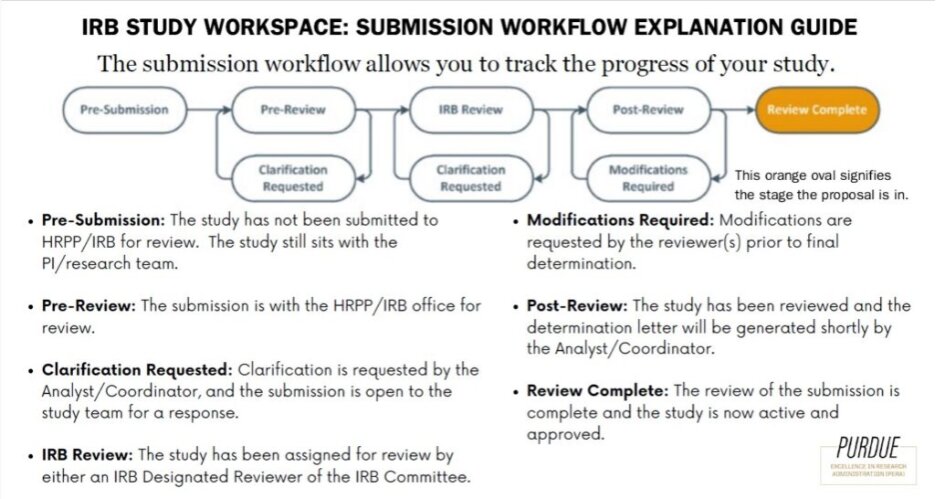
Submission workflow stages:
- Pre-Submission: The study has not been submitted to HRPP/IRB for review. The study still remains with the PI/research team. The IRB cannot review in this state.
- Pre-Review: The submission is with the HRPP/IRB office for review. It is going through a pre-review to prepare it for the designated reviewer or the convened IRB.
- Clarification Requested: Clarification is requested by the Analyst/Coordinator, and the submission is open to the study team for a response.
- IRB Review: The study has been assigned for review by either an IRB Designated Reviewer or the IRB Committee.
- Modifications Required: Modifications are requested by the reviewer(s) prior to final determination.
- Post-Review: The study has been reviewed and the determination letter will be generated shortly by the Analyst/Coordinator.
- Review Complete: The review of the submission is complete and the study is now active and approved.
Step 6: Respond to the IRB
- Respond promptly to requests for revisions or clarification
- All communications are sent to the Principal Investigator and Primary Contact
- Timely responses help reduce review delays