Post-Approval Monitoring
The Post Approval Monitoring (PAM) team within the Human Research Protection Program aims to ensure the well-being of humans involved in research. Authorization for investigators to work with human participants begins with an approved study from Purdue’s Human Research Protection Program/Institutional Review Board (HRPP/IRB). Research protections and record retention requirements continue throughout a project and after study closure.
Regular monitoring of ongoing research is essential to protecting human participants. Purdue’s HRPP is accredited by AAHRPP, and the Post-Approval Monitoring (PAM) program helps Purdue maintain that accreditation. PAM also creates opportunities for researchers and Purdue’s regulatory committees to communicate, share guidance, and learn from one another.
Post-Approval Monitoring may be conducted through either a scheduled meeting or a self-assessment. The Post-Approval Monitor will select the appropriate method and identify it in the initial contact email. Investigators whose studies are selected for a scheduled monitoring visit may also complete the self-assessment form for organizational purposes; however, doing so does not replace the required scheduled visit.
Scheduled Visits
The following infographic summarizes the essential steps of a Post Approval Monitoring visit:
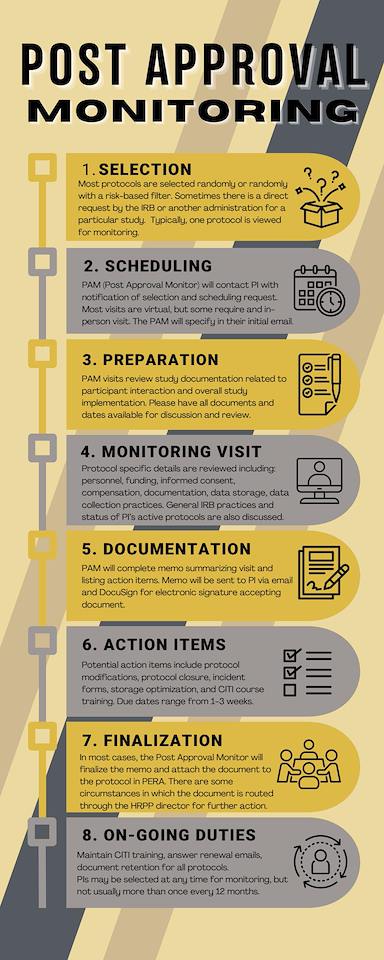
- Selection — Most protocols are selected randomly or randomly with a risk-based filter. Sometimes there is a direct request by the IRB or another administration for a particular study. Typically, one protocol is viewed for monitoring.
- Scheduling — PAM (Post Approval Monitor) will contact the PI with notification of selection and a scheduling request. Most visits are virtual, but some require an in-person visit. The PAM will specify in their initial email.
- Preparation — PAM visits review study documentation related to participant interaction and overall study implementation. Please have all documents and dates available for discussion and review.
- Monitoring Visit — Protocol-specific details are reviewed including: personnel, funding, informed consent, compensation, documentation, data storage, data collection practices. General IRB practices and status of the PI’s active protocols are also discussed.
- Documentation — PAM will complete a memo summarizing the visit and listing action items. The memo will be sent to the PI via email and DocuSign for electronic signature accepting the document.
- Action Items — Potential action items include protocol modifications, protocol closure, incident forms, storage optimization, and CITI course training. Due dates range from 1–3 weeks.
- Finalization — In most cases, the Post Approval Monitor will finalize the memo and attach the document to the protocol in PERA. There are some circumstances in which the document is routed through the HRPP director for further action.
- On-going Duties — Maintain CITI training, answer renewal emails, document retention for all protocols. PIs may be selected at any time for monitoring, but not usually more than once every 12 months.
Self Assessments
In most cases, exempt studies are monitored through an online self-assessment. Investigators whose protocols are selected will receive an email with completion instructions and a unique link to the Qualtrics self-assessment tool. After the assessment is submitted, the Post-Approval Monitor will review the responses and determine whether follow-up action is needed. The investigator will then receive a summary memo that outlines any required tasks and provides instructions for completing them. Once finalized, the memo will be attached to the study in PERA.
For more information about Post-Approval Monitoring, please view the following documents:
- HRP-096 – SOP – Post Approval Monitoring — Procedure for Post Approval Monitoring selection, implementation, and reporting.
- Monitoring Form — This is not required for investigators to complete. Use this link to review the information collected at a Post Approval Monitoring visit.
FAQs
As outlined in HRP-096-SOP, Post-Approval Monitoring, studies may be selected randomly, for cause, or through a risk-based assessment. These methods support appropriate oversight of approved studies. A monitoring visit may also be conducted when potential concerns or risks are identified to confirm that study procedures are being carried out as approved.
When a study is randomly selected, the Post-Approval Monitor will notify the principal investigator (PI) and request a meeting. The initial email will identify the study name and number, explain how the study was selected, such as randomly or by direction, and state whether the visit will be virtual or in person. PAM visits are typically scheduled within three weeks of the initial contact.
Before contacting the PI, the Post-Approval Monitor reviews the selected study to determine whether any activities or documents must be examined in person to verify compliance with the IRB-approved study. Studies that involve in-person data collection typically require an in-person meeting. Studies conducted primarily online may be reviewed through a virtual meeting.
The PI and research personnel responsible for participant interactions, interventions, or study recordkeeping should attend the PAM visit. Because the PI is responsible for study activities, the PI is expected to serve as the primary contact throughout the PAM process and must be present at the PAM visit.
The Post-Approval Monitor will meet with the PI and any identified members of the research team. In most cases, the Monitor will use the Monitoring Form to guide the visit. PIs may review the form in advance to understand the questions that will be discussed and the materials that will be reviewed.
Yes. If research has not yet begun, the Post-Approval Monitor may review the study’s status and help the investigator determine appropriate next steps.
If research activities are ending, the Post-Approval Monitor will review study records and document-retention requirements with the PI and research team.
If research has ended but the protocol has not been officially closed, the Post-Approval Monitor will review the study records, document-retention requirements, and steps required to submit a closure request.
After the monitoring visit, the Post-Approval Monitor will send the PI a formal memo summarizing the topics discussed, any identified discrepancies, and assigned action items with target completion dates. The PI should notify the Monitor of any discrepancies or unresolved points within 15 business days of receiving the memo. The PI and PAM will then electronically sign the memo to acknowledge that its contents are accurate and that they agree on any required resolution items.
Common Post Approval Monitoring resolutions may include:
- Minor protocol modifications (e.g. personnel updates, enrollment allotment, funding update, study time frame, etc.): HRP-103 – Investigator Manual, How do I submit a modification?
- Study closure(s) for inactive protocols: HRP-103 – Investigator Manual, When and how do I close out a study?
- Report of New Information (e.g. non-compliance, adverse event, formal external audit, participant complaint, etc.): HRP-103 – Investigator Manual, What if something goes wrong with my study?
Most PAM visits are intended to be educational and informative, reflecting the shared goal of protecting human research participants.